Skip to content

Development and characterisation of human iPSC-derived 3D neurospheres for drug discovery

Human iPSC-derived 3D neurospheres for CNS disease modelling and drug discovery
Download now
Screenshot 2026-10-20 at 10.16.47 AM

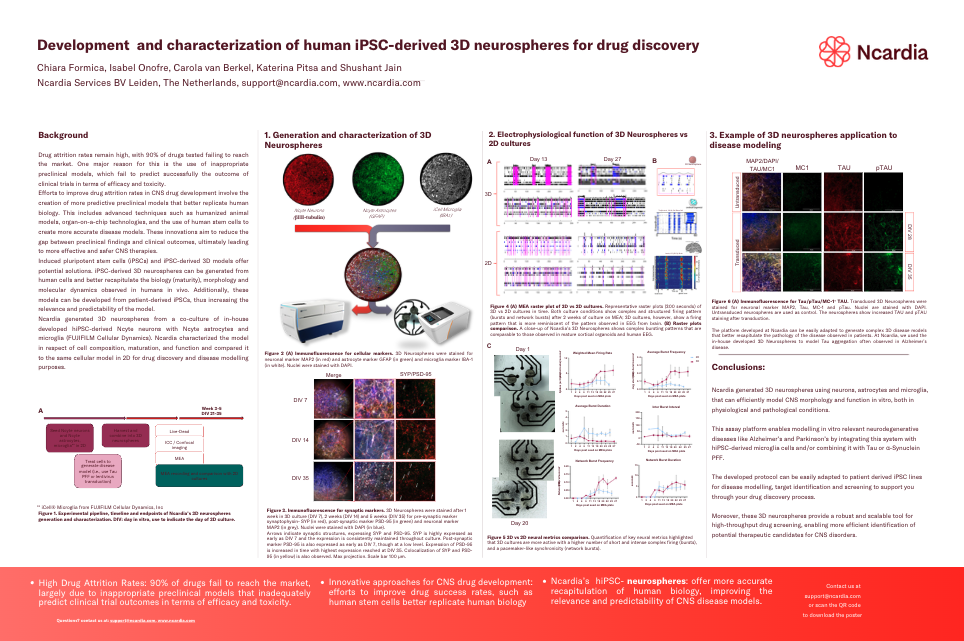
This poster presents Ncardia’s development and characterisation of human iPSC-derived 3D neurospheres, combining neurons, astrocytes and microglia to investigate neuronal maturation, network activity and disease-related pathology. The study compares 3D neurospheres with 2D neuronal cultures and explores their application in neurodegenerative disease modelling.

Download it now for a closer look at:

  • How human iPSC-derived neurons, astrocytes and microglia are combined to generate 3D neurospheres, with characterisation of cellular composition and synaptic development

  • How multi-electrode array (MEA) recordings reveal differences in neuronal firing patterns between 2D and 3D cultures, including complex bursting and synchronised network activity

  • How synaptic markers, including synaptophysin (SYP) and PSD-95, develop over time in 3D neurospheres, providing insights into neuronal maturation

  • How 3D neurospheres can be adapted for neurodegenerative disease modelling, demonstrated through increased Tau and phosphorylated Tau staining following transduction

Download the Poster


Get the Poster Now!

Whether you are investigating neuronal network function, studying neurodegenerative disease mechanisms or developing screening assays, Ncardia’s human iPSC-derived 3D neurospheres provide a platform for exploring CNS biology in a multicellular, three-dimensional environment.


Download the poster by filling out the form below: